
Match Each Ownership Era to Its Best Source
No single Presque Isle County collection covers every former owner in one format. Each era has its best source. The modern deed index is the practical opening. The Register's books carry the chain earlier, and archival collections help reconstruct nineteenth- and twentieth-century clues, so a dated research log keeps a directory name from being mistaken for a titled owner.
| Source | Documented years | Where held | What it contributes |
|---|---|---|---|
| GovOS computerized index | November 1, 1978 forward | Online and Register of Deeds | Modern indexed deeds and related instruments |
| County land books | Early 1850s forward | Register of Deeds vault, Rogers City | Older grantor-grantee references and recorded documents |
| Deeds, RG 75-3 | 1856-1940 | Archives of Michigan | Historic conveyances overlapping county books |
| Mortgages, RG 75-3 | 1858-1923 | Archives of Michigan | Financing parties and possible ownership-era context |
| Assessment rolls, RG 83-103 | 1878-1920 | Archives of Michigan | Taxed names and property clues, subject to deed confirmation |
| County directories | 1950-1982 | Library of Michigan | Address and household context, not title proof |
| Historic newspapers | Runs vary from 1878 onward | State and district library collections | Sales, estates, fires, businesses, and community context |
Start with the Newest Deed, Not the Oldest Name
Today's parcel is the stable anchor. Search Presque Isle County BS&A by address, name, or parcel number. Copy the parcel code, current owner, situs, mailing address, local unit, and legal description from the card. A tax-roll owner can lag a newly recorded transfer. Use it as a lead. Then confirm with the newest deed.
Search the current owner's exact name in GovOS Public Search, starting as a likely grantee. Narrow the dates if the tax card or sale information points to a window. Open or order the acquisition deed. Check that its legal description matches the subject parcel. The grantor on that deed is your strongest candidate for the immediately previous owner.
Build the Previous-Owner Chain Backward
A reliable chain is a sequence of document-to-document links. Every link must preserve the land identity, not just the names of the people involved.
- Record the newest deed's grantor, grantee, recording date, document number or book/page, and complete property description.
- Search that grantor as a grantee during an earlier date range. Try initials, former surnames, trust or estate capacities, and business suffix variants when appropriate.
- Compare the next deed's land description, referenced prior instrument, and conveyed interest. Stop and resolve any parcel split, exception, or mismatch.
- Repeat until the computerized index reaches its November 1, 1978 boundary, then take the last usable reference to the courthouse books.
- Grantor / grantee
- The conveying party and the receiving party shown on an instrument.
- Chain of title
- The ordered series of conveyances affecting the same land.
- Legal description
- The land identifier that can survive address changes and distinguish same-name owners.
- Recording reference
- The document number or book/page used to retrieve the filed instrument.
Let the Legal Description Control Same-Name Matches
Former owners often share surnames. One person or company may have held several parcels. A name match without the same land is not a link. Compare lot and block, subdivision, section-township-range calls, acreage, exceptions, and references to earlier documents. If part of a tract sold, branch your notes rather than forcing one continuous line. Same-name care matters most where descriptions get fuzzy.
Street labels are weaker identifiers. Rural route changes, E911 renumbering, and postal-city labels all alter how an address reads. Shifting municipal boundaries alter it too. A recorded plat or deed description can bridge those shifts. Printed plat books and atlases orient you well. But their lines are not a survey. Their owner labels are not certified title. That distinction keeps your previous-owner list attached to the right land.
The 1978 Cutoff Changes the Search Method
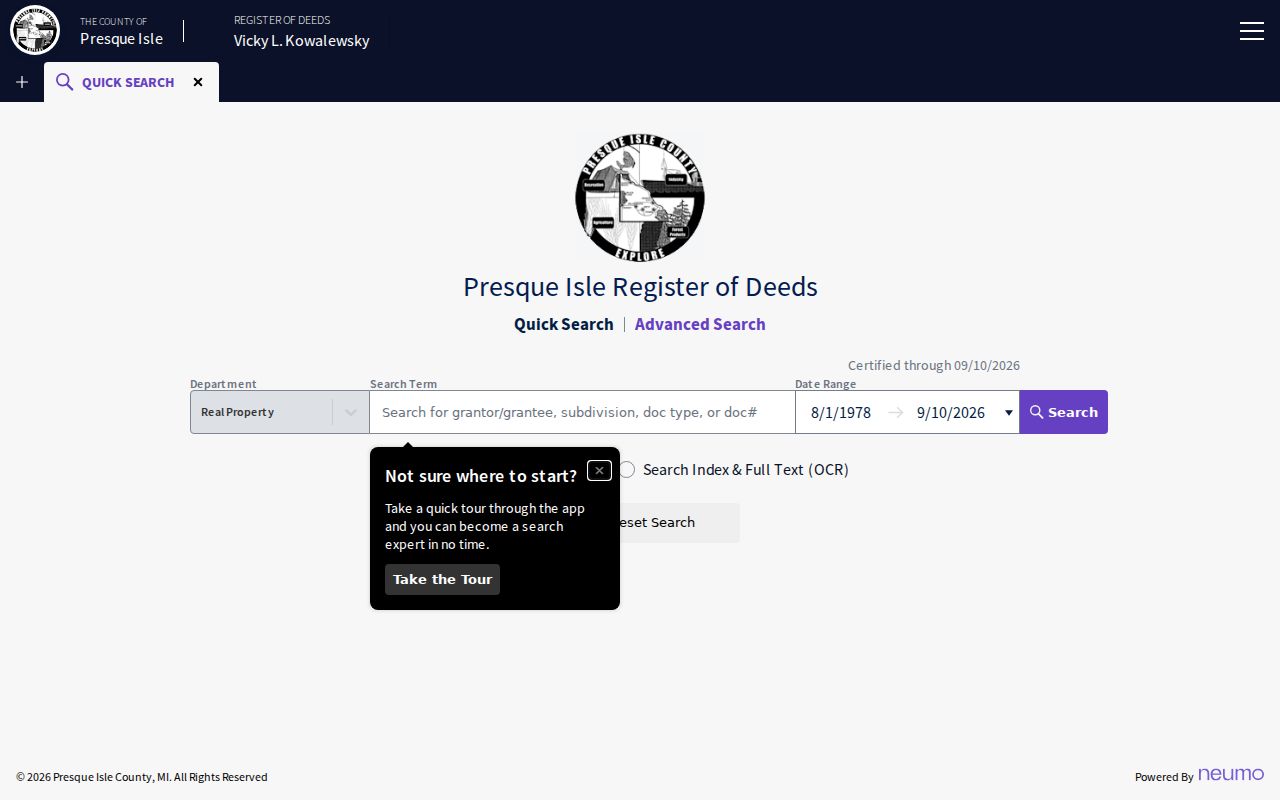
GovOS is the county's computerized layer from November 1, 1978 forward. Its absence earlier proves nothing. The quick form searches a term as grantor, grantee, subdivision, document type, or document number, with recorded-date, image, index-only, and full-text OCR options. Index-only mode matches words individually. Full-text mode treats multiple words as one phrase. Run both modes, since OCR can miss faint print and unusual names.
Resolve Estate, Trust, and LLC Breaks Instead of Skipping Them
A prior-owner sequence may run through an executor, administrator, surviving owner, trustee, or company. Search the deed exactly as indexed, fiduciary capacity included. For a probate conveyance, the Presque Isle County Clerk and the 53rd Circuit probate file may hold the estate number, letters of authority, inventory, petition, or order explaining the transfer. Access rules apply. MiCOURT is a locator only. It is not the official court file, and wills are excluded from its public results.
A deed naming an LLC or corporation calls for a different check. Michigan's MiBusiness Registry confirms the entity's legal name, status, formation or authorization date, registered office, resident agent, and filings. It does not establish any real estate transfer. A trustee's or agent's personal name should never substitute for the grantee. That conclusion needs support from another recorded instrument.
Older Books Reach the Early 1850s
The Register of Deeds reports county land records back to the early 1850s. Public hours run 8:00 a.m. to 4:30 p.m. weekdays, with vault hours 8:15 a.m. to 4:15 p.m. The office answers at 989-734-2676 or registerofdeeds@picounty.org. Bring the most recent pre-1978 grantor, grantee, date range, legal description, and book/page reference so a request stays specific.
The Archives of Michigan guide lists deeds for 1856-1940, mortgages for 1858-1923, statements of taxes on returned lands for 1873-1882, and state-tax-land sale abstracts for 1876-1880. Presque Isle County was laid off in 1840 and organized in 1871. That gap explains why early land activity needs careful historical framing. No official source records a courthouse fire destroying the land books. Investigate a missing entry instead of blaming an unverified loss.
Historic Assessment Rolls Supply Clues, Not a Substitute Chain
Archives of Michigan holds assessment rolls for the years 1878 through 1920. A 1940 rural property inventory also survives for Metz and Bearinger townships. A taxed name in a roll can place a person near a parcel or locality between deed events. Statements of taxes on lands returned, along with state-tax-land sale abstracts, may even explain why a family lost ground to tax distress. Remember, though, that assessment habits, property descriptions, and liable parties do not always match deed vesting in Presque Isle County.
Newspapers and Directories Add the People Behind the Chain
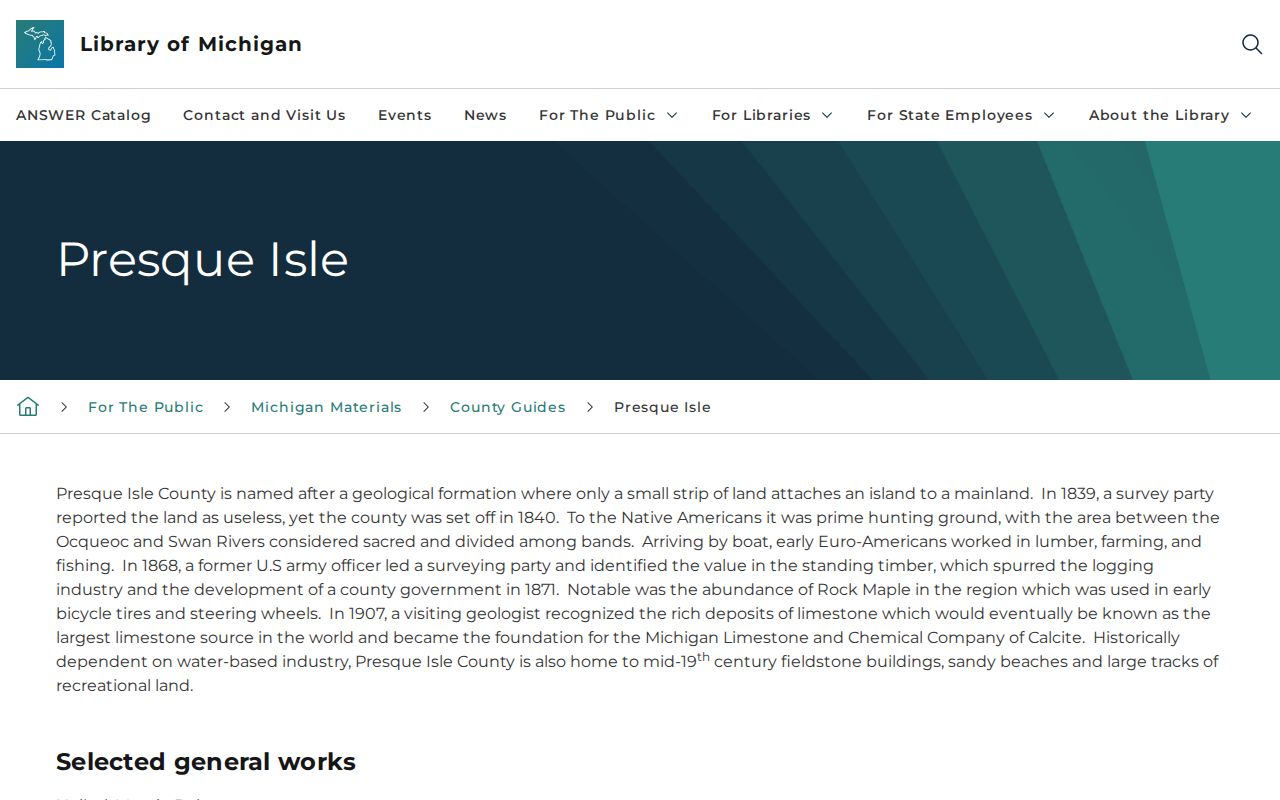
Old newspapers and directories put names and faces beside the chain of title. The Library of Michigan county guide catalogs county directories spanning 1950 through 1982. Its historic plat books cover 1930, 1958, 1963, 1967, 1970, and 1974. Newspaper runs go back even further. Holdings include the Presque Isle County Advance in runs starting in 1878, the Onaway Outlook from 1900 to 1939, the Onaway News from 1939 to 1972, the Presque Isle County News from 1901 to 1913, and the Millersburg Tribune from 1900. The Presque Isle District Library holds local material. Its newspapers, cemetery books, family histories, and digital collections supplement county property records.
A directory listing, a plat-book name, or a household in the paper is not proof of title. Treat each as contextual evidence. Any ownership claim still needs the deed that confirms the owner of record.
Know Where the Former-Owner History Stops
County land books and archival deeds hold real depth. A property records search in Presque Isle County can reach deep into the nineteenth century through them. Still, the earliest locally recorded conveyance is not always the original government patent. Unrecorded interests may sit outside the deed records entirely. A chain may predate county organization. It may also touch federal or state land. In that case, ask the Register and the Archives of Michigan which patent, tract, or state-land resources apply. Label record gaps, illegible pages, description changes, and unrecorded family arrangements honestly.
Copies from the Register run $1 per page. Certification adds $5. After the index search, online images can be bought through GovOS. Older material requires office or archival arrangements. For legal ownership and marketability, rely on a title insurer, attorney, or other qualified professional.
Lawful house-history use. Former-owner research is appropriate for title diligence, genealogy, preservation, and understanding a property's history. Do not use addresses or names to stalk, harass, threaten, or attempt to defeat Michigan's Address Confidentiality Program.