Which Recorded Instruments Change or Explain Title?
The Presque Isle County Register of Deeds records instruments that meet Michigan recording requirements, though the office does not prepare forms or give legal advice. Start by identifying what an entry actually is. A deed transfers an interest in property. A different filing may finance, restrict, release, or clarify that interest.
| Instrument | Record effect | Typical reason to inspect it |
|---|---|---|
| Warranty deed | Conveys the stated interest with covenants in the instrument | Ordinary purchase or formal transfer |
| Quitclaim deed | Passes whatever interest the grantor holds | Family, estate, marital, or corrective transfer |
| Land contract | Documents contractual purchase rights and duties | Seller-financed transaction |
| Fiduciary deed | Shows a trustee, executor, or administrator conveying under authority | Trust or probate chain |
| Tax or sheriff's deed | Records a conveyance following the applicable foreclosure process | Distressed-property history |
| Mortgage, lien, or lis pendens | Places a financing interest, claim, or litigation notice in the record | Possible encumbrance requiring later review |
| Release, discharge, or assignment | Releases or moves an earlier recorded interest | Following an encumbrance through its later history |
| Easement, covenant, or plat | Describes access, restrictions, or subdivision context | Understanding rights referenced by a deed |
A deed's category alone proves nothing. Read the parties, the legal description, both dates, and every referenced instrument before drawing conclusions. A quitclaim deed, for instance, only conveys whatever interest the grantor happened to hold.
Presque Isle's Online Deed Index Starts in 1978
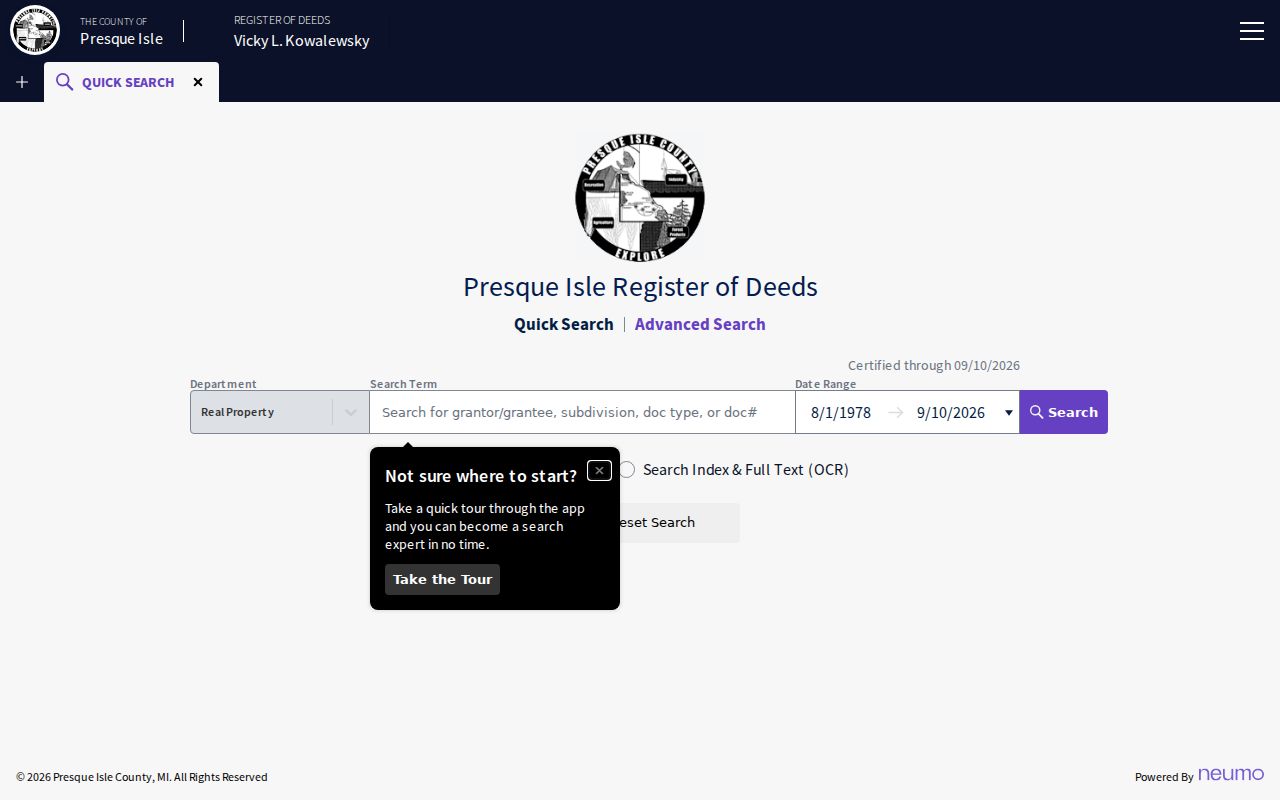
The county's GovOS Public Search opens the computerized deed index. That index covers recordings made on or after November 1, 1978. Start with the quick form, which is a Real Property search. Its Search Term accepts a grantor or grantee name. It also takes a subdivision, a document type, or a document number. Date boundaries can frame the hunt. Users choose between recorded-date and image results, limit a query to the last 24 hours, and search the index by itself or alongside full text generated by optical character recognition.
| Portal control | Useful input | Search caution |
|---|---|---|
| Search Term | Party name, subdivision, instrument type, or document number | Confirm the legal description in the document |
| Recorded Date | From and through dates | Recording can occur after execution or closing |
| Index Only | Indexed names and fields | Two or more words are searched individually |
| Index & Full Text | A phrase expected within scanned text | OCR can misread handwriting, faint type, or unusual names |
| Image option | Documents with image availability | Confirm purchase terms shown by the live portal |
Walk the Grantor-Grantee Chain One Transfer at a Time
A deed chain belongs to a parcel, not a surname. First pin down the property through BS&A Online, recording the current owner, parcel code, situs, and legal description. That owner then becomes the likely grantee in the deed index.
- Find the current owner's newest acquisition deed and record its grantee, grantor, recording date, document number or book/page reference, and land description.
- Compare that deed's description with the subject parcel. Note splits, combined parcels, lots, sections, easements, and references to earlier instruments.
- Search the named grantor as a grantee during the preceding period. Open the matching acquisition deed and repeat the same capture.
- When the chain reaches November 1, 1978, continue with the Register of Deeds' physical indexes and deed books rather than assuming the property has no earlier history.
- Grantor
- The party conveying or granting the stated interest.
- Grantee
- The party receiving the interest shown by the instrument.
- Chain of title
- The chronological sequence of recorded transfers affecting the same land.
- Book/page or instrument number
- The recording reference used to retrieve a filed document; preserve exactly what the record displays.
Capture the Index Entry Before Buying an Image
Save the index entry before paying for anything. For each candidate deed, note the party spellings and party roles. Note the document type, recorded date, and displayed retrieval reference too. Not every result row shows a parcel or full legal description. Never assume one is there. The purchased or office copy confirms the complete description. It also shows any consideration, reservations, exceptions, or references. Run name variants on purpose. Hyphenation, middle initials, estate labels, trust names, and business suffixes each alter an index hit. The portal also handles multiple terms differently in index-only and OCR modes. A failed phrase search calls for separate-word searches. Try a subdivision search or a document-number search next. That result is not a verdict that no deed exists.
Bridge Probate, Trust, and Business-Entity Transfers
A tidy seller-to-buyer sequence often pauses. The pause may come at an estate, a trust, a land contract, or a limited-liability company. An executor or administrator signature sends you to the 53rd Circuit probate file through the county Clerk. That file holds the authority and order behind the conveyance. An LLC or corporation sends you to Michigan's MiBusiness Registry. There you can confirm the exact legal name, entity status, registered office, resident agent, and filings. Keep one caution in mind. A registered agent is a service contact. It is not evidence that the agent owns the land personally. Copy trust and estate names exactly as the deed spells them. Search the plausible individuals and fiduciary capacities separately instead of collapsing them into one person. Court, business, and tax records can explain a transition. Yet the recorded conveyance remains the property evidence.
Earlier Deed Books Remain a Courthouse and Archives Project
The Register of Deeds reports land records reaching back to the early 1850s. Public hours run 8:00 a.m. to 4:30 p.m. on weekdays. The vault opens at 8:15 a.m. and closes at 4:15 p.m. Recording is accepted until 4:00 p.m. The office sits within the county courthouse network in Rogers City. Reach it at 989-734-2676 or registerofdeeds@picounty.org. Ask how names and volumes are arranged before visiting. Bring the newest pre-1978 reference already in hand. The Archives of Michigan county guide identifies deeds from 1856 through 1940 in record group RG 75-3. It also lists mortgages from 1858 through 1923. Those holdings overlap the courthouse chronology and suit planned archival work. Presque Isle County was laid off in 1840 and organized in 1871. Early land history and later county administration belong to different eras of recordkeeping.
Use Plats and Legal Descriptions to Keep the Land Constant
Street addresses change. Rural routes shift, E911 readdressing renames roads, and city or township mailing labels move over time. A subdivision, a lot and block, or a section-township-range description usually bridges old and new records far better. So does a prior instrument reference. Recorded subdivision plats live in the land-record system. The County Clerk also sits on the County Plat Board.
The MSU Extension's 2023 county plat book adds road and landowner context. Older Library of Michigan atlases help too. Neither one replaces a recorded plat, a boundary survey, or a deed. Use maps to develop search terms. Then return to the recorded instruments that actually establish the chain.
Order Plain or Certified Presque Isle Deed Copies
Modern deed images are sold through GovOS. Copies become available once documents are certified and payment clears. The county says that normally happens the next business day. Published charges are $1 per page plus $5 for certification. The $30 figure on the office page is the recording fee, not the copy price. Where applicable, additional libers or instruments add $3 each. A transaction total is not always displayed. Check the live portal, or contact the office for the exact amount.
Ordering from an older book takes a bit more detail. Send or bring the party names, the approximate date, and a document number or book and page reference. Include the property description, the certification status you want, and return contact information. An institution or proceeding may require the custodian's certification. In that case, a certified copy is the right choice. For preliminary house-history notes, a plain copy is usually enough.
Recorded, not guaranteed. The index shows instruments accepted into the county record. It is not a title opinion and cannot establish that every interest was recorded or released. Obtain the actual documents and use a qualified title professional or attorney for a legal conclusion.
Property Alert Watches Names, Not Title Quality
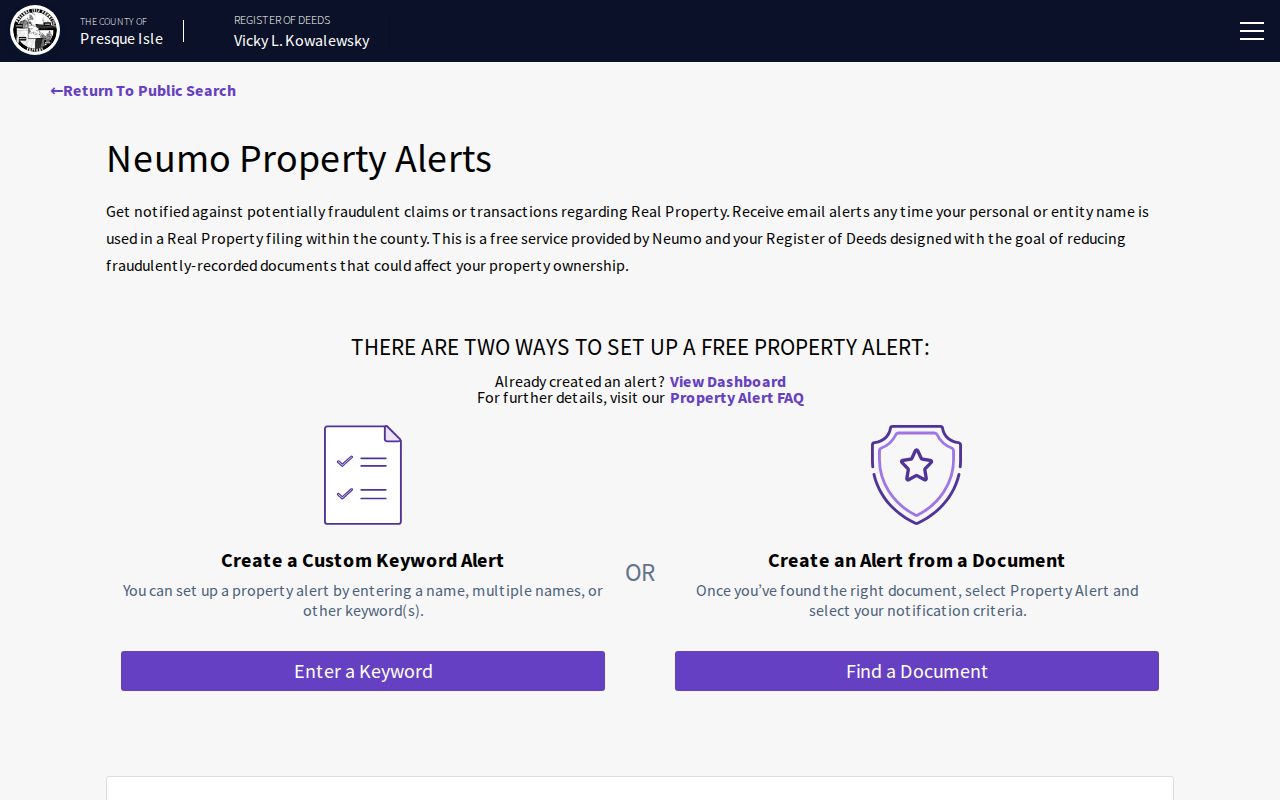
The county offers a free Property Alert or Fraud Sleuth notification service. It is linked from its site. Enrollment flags new recordings in a person's name for review. That is where its protection ends. The service does not prevent a filing, verify authenticity, or insure title. Compare any notice against the recorded document itself. Report anything unfamiliar to the Register of Deeds promptly.